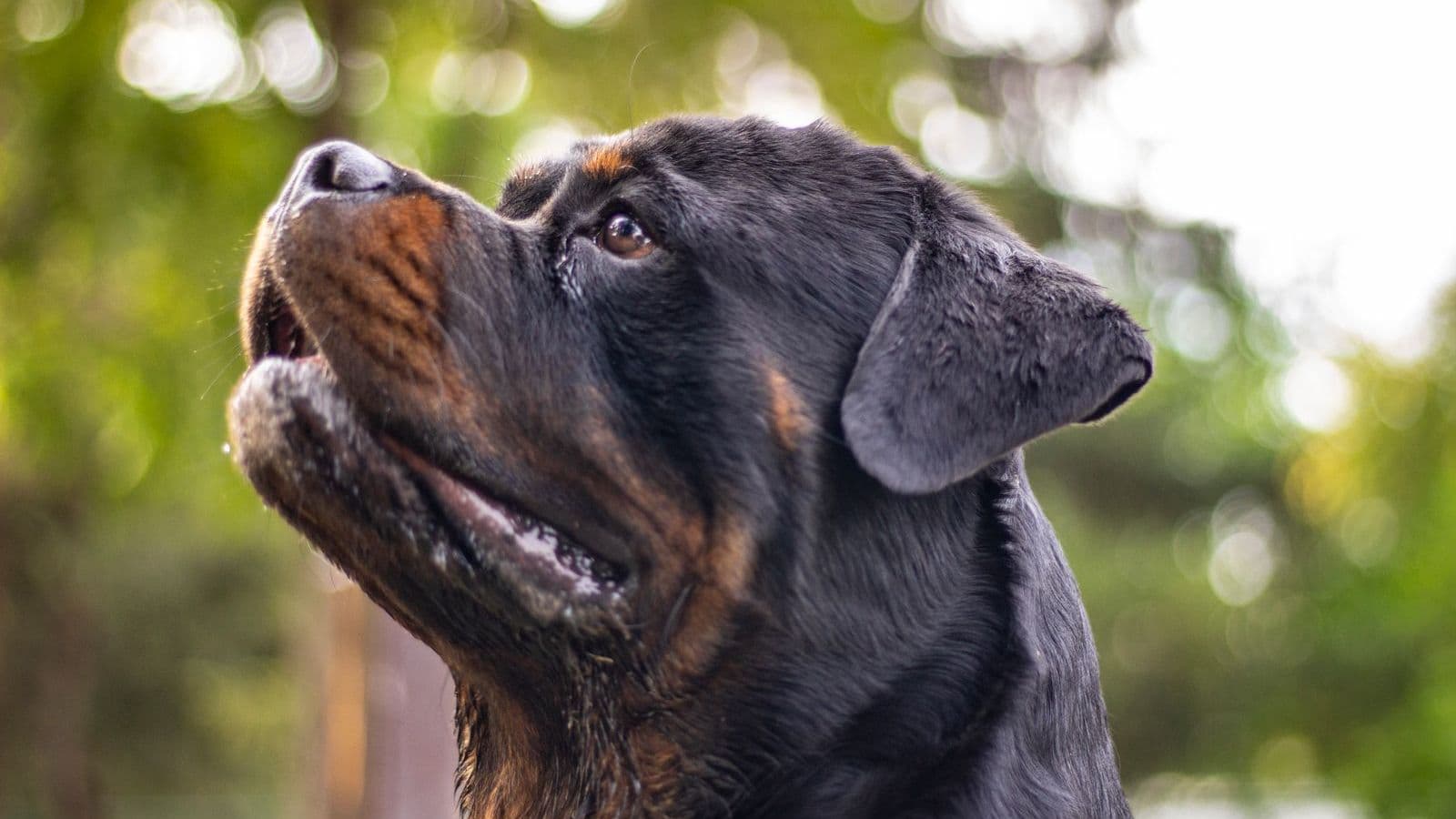
The Rottweiler comes from Roman cattle-driving dogs. These dogs marched with Roman legions across the Alps two thousand years ago. After Rome fell, the breed lived on in the German town of Rottweil. Butchers there used them to drive cattle to market and pull carts full of meat. That history still shows up in your Rottweiler today: physical power, confidence around big animals, deep loyalty to one family, and a natural wariness of strangers.
This is not a breed you can train halfway. Done well, a Rottweiler becomes one of the most capable, loyal, and calm dogs you can own. Done poorly, the same dog becomes a real problem. Here is the approach that works.
At a glance:
- Trainability: 9/10, calm and confident, genuinely enjoys having a task and a handler
- Biggest risk factor: under-socialization, develops reactivity faster than most breeds without it
- Maturity note: full size by 18 months, but mental maturity takes close to 3 years
- Example: a Rottweiler "teenager" between 12 and 24 months can regress on known commands, that's normal development, not failure
- Not for: owners who won't commit to heavy socialization in the first 16 weeks
What Makes Training a Rottweiler Different
1. They grow up slowly. Rottweilers reach full size by 18 months, but their minds don't fully mature until close to age 3. The "teenager" phase between 12 and 24 months is hard. Dogs forget known commands, test limits, and act like giant puppies. This is normal growth, not a training failure.
2. They are natural guard dogs. Their old cattle-driving job needed a protective instinct, but without random aggression. Modern Rottweilers still have this. They watch strangers closely. They size up situations before acting. Good training turns this into a calm, controlled trait. Poor training can turn it into reactive guarding.
3. They bond deeply with one family but stay reserved with strangers. This is just how the breed works. Trying to make a Rottweiler friendly with every stranger goes against its nature and will not work. Instead, train them to stay calm and neutral around strangers. Neutral is the goal, not friendly-with-everyone like a Labrador.
4. They are strong and need the right gear. A 100-pound Rottweiler that pulls hard can hurt you. Use solid gear: a front-clip harness for daily walks and a well-fitted collar for ID and control. Start leash training early. You cannot fix a 2-year-old dog's pulling if you skipped training at 4 months.
Are Rottweilers Easy to Train ?
Yes, more than the reputation suggests. Rottweilers score 9/10 on our trainability index : calm, confident, deeply bonded working dogs that genuinely enjoy having a task and a handler.
- What is easy : obedience and working structure, Rotties learn fast and retain beautifully, and the medium energy keeps sessions focused.
- What takes work : early socialization, thorough and non-negotiable for a powerful guardian breed, plus manners installed before full mass arrives.
- The catch : sensitivity under the muscle. Harsh handling backfires into anxiety or resistance; reward-based training gets the famous Rottweiler devotion working for you.
Trainable, steady, and serious : an excellent student for an owner who shows up consistently.
Week-by-Week Training Plan for Your Rottweiler
Weeks 1 and 2 : Foundation and Heavy Socialization
The most critical window for Rottweilers is between 8 and 16 weeks. This breed develops reactivity faster than most when under-socialized. Heavy, controlled exposure to people, dogs, environments, surfaces, and sounds is mandatory.
- Daily training : 5 minute sessions, 3-4 times per day. Foundation work on name recognition and engagement.
- Daily socialization : 2-3 brief novel exposures (different people, different surfaces, different environments). Always controlled, always positive.
- Use high-value treats. Rotties are food-motivated when something better than kibble is offered.
The puppy you raise during these 8 weeks determines the adult dog you'll live with for the next 10 years. Don't skip socialization. Don't wait for full vaccinations. Use sensible precautions and get the dog out.
Weeks 3 and 4 : Sit, Down, Stay, Heel Position
Rotties learn sit and down in 3-5 reps. They learn stay over 3 weeks. The challenge is duration and precision, not initial learning.
- Lure sit, mark when bottom hits ground, add verbal cue after 15 reps.
- Lure down from sit. Some Rotties resist lying flat at first. Reward partial progress.
- Stay : start at 5 seconds (the breed has natural impulse control), build to 1 minute by end of week 4.
- Begin heel position : the dog sits at your left side, head aligned with your knee. This is the foundation of leash control for a strong breed.
Weeks 5 and 6 : Loose Leash and Counter-Conditioning
For a Rottweiler, leash training is non-negotiable. A 100-pound adult Rottweiler pulling at full strength can dislocate a shoulder or yank you into traffic.
Stop-and-stand method : the instant the leash tightens, you freeze. Don't pull back. Don't speak. Wait for slack. Reward and continue when the leash goes loose. The first walk takes 30 minutes to cover 200 feet. Accept this. Within 4-6 weeks of consistent application, the behavior installs.
Add counter-conditioning during walks : when the Rottweiler notices another dog at distance (their threshold), mark and reward heavily. Build the positive association before reactivity has a chance to develop. The breed is naturally watchful, so this work prevents reactivity from becoming a problem at 1 year.
Front-clip harness is recommended for everyday walking until leash skills are completely solid (usually 8-12 months of consistent training).
Weeks 7 and 8 : Recall
A Rottweiler without solid recall is a public safety concern. The breed is generally not a bolter, but their power and watchfulness mean a Rottie who decides to investigate something can move fast and intimidate people unintentionally.
Train recall in low-distraction environments first. Use a 30-foot long line for 6-8 weeks before trusting off-leash. Use jackpot rewards (entire pieces of chicken, not just bites) for excellent recalls. Never use the recall word for anything negative (bath, vet, end of fun).
By end of week 8, recall should be 80% reliable in low-distraction environments. By week 12, 90% in moderate distraction. Full off-leash reliability across all environments takes 18-24 months with continued practice.
Weeks 9 and 10 : Place Training and Impulse Control
Rotties need a settle skill. A working dog with this much drive must learn to switch off when not on duty.
Place training : the dog learns that a designated mat or bed is their spot. Lure onto the mat, mark and reward calmly (reward stillness, not excitement). Add the verbal "place" cue after 20 successful lures. Build duration from 30 seconds to 30 minutes over 2 weeks. Practice in different rooms, then around distractions.
A Rottweiler with solid place training can settle at a café, while you work, or when guests visit. Without it, the breed paces, watches, and develops problematic alertness behaviors.
Weeks 11 and 12 : Public Practice
Final phase. Take everything they know into structured public environments :
- Sit and down at outdoor cafés (with mat training)
- Heel past other dogs without breaking position
- Recall in fenced areas with moderate distractions
- Settle at the vet, the groomer, or busy public spaces
The goal is a Rottweiler who can function in normal society as a calm, controlled, confident dog. Not effusively friendly with strangers. Not aggressive. Neutral, watchful, responsive to handler. That's the target.
Common Rottweiler Training Mistakes
Mistake 1 : Under-socializing. The most damaging error for the breed. Under-socialized Rotties develop fear-based reactivity that takes years to address.
Mistake 2 : Encouraging guarding behaviors. Praise for barking at strangers, growling at the mail carrier, or "protecting the house" creates unstable, reactive adults. Reinforce calm neutrality instead.
Mistake 3 : Punishment-based training. The breed responds far better to positive reinforcement. Modern working dog training (police, military, Schutzhund) has shifted away from corrections because they produce less reliable dogs.
Mistake 4 : Inconsistent rules. Rotties bond with primary handlers and may ignore secondary ones. Every household member must enforce identical rules. Full breakdown : Rottweiler training mistakes.
Frequently Asked Questions
How long does it take to train a Rottweiler ? Basic commands in 12 weeks. Reliable adult behavior at 24-36 months. The breed matures slowly. Adolescent regression (12-24 months) is normal and not a training failure.
Are Rottweilers aggressive ? Properly bred, properly raised Rottweilers are not aggressive. They are watchful, reserved with strangers, and protective of family. Aggression is the result of poor breeding, under-socialization, or mishandling. A well-raised Rottie is calm and confident.
Can I train a Rottweiler at home without a professional ? For pet-level obedience and behavior, yes, with a structured plan. For protection sports or any reactive behavior issues, professional guidance accelerates progress and prevents mistakes. First-time owners often benefit from at least a few sessions with a positive-reinforcement-based trainer experienced with working breeds.
Why is my Rottweiler so vocal at 6 months ? Adolescent Rotties test boundaries and may become more vocal as they enter the watchful phase. This is normal breed development. Address it through consistent training (reward quiet, manage triggers) and adequate exercise. By 24 months, vocal tendencies typically stabilize.
Is positive reinforcement really the best method for a strong breed like Rottweiler ? Yes, and increasingly the standard at the elite working level. Modern police and military K9 programs use reward-based training because it produces more reliable dogs. The American Veterinary Society of Animal Behavior recommends positive reinforcement for all breeds. For Rottweilers specifically, the method produces stable, confident adults. Corrections produce reactive or shut-down dogs.
Can I socialize my Rottweiler at 6 months if I missed the early window ? You can do significant work, but the dog you're socializing at 6 months is harder to shape than the one you socialize at 10 weeks. Use a force-free trainer experienced with the breed. Counter-conditioning protocols can help. Full reactivity prevention is much harder after the critical window closes.
How much exercise does a Rottweiler need ? 60-90 minutes of physical exercise daily, plus 20 minutes of mental work. Walks are insufficient on their own, the breed needs structured activity, fetch, swimming, hiking, or formal training sessions. Working-line Rotties need more.
Why TailorPup Was Built for Rottweilers
Generic training apps don't account for the breed's slow maturation, the natural watchfulness that becomes reactivity if mishandled, or the need for heavy socialization in the first 16 weeks. TailorPup's Rottweiler plan front-loads socialization, builds counter-conditioning foundations early, calibrates session length to the breed's attention span, and adjusts for adolescent regression.
Daily 12-minute sessions, adjusted weekly based on your dog's progress. Plans from $9.99/month, no trial; annual starts at $2 for 7 days. Cancel anytime.
Related : Rottweiler Training Mistakes · Reactivity Training · Recall Training Guide · Leash Pulling Solutions