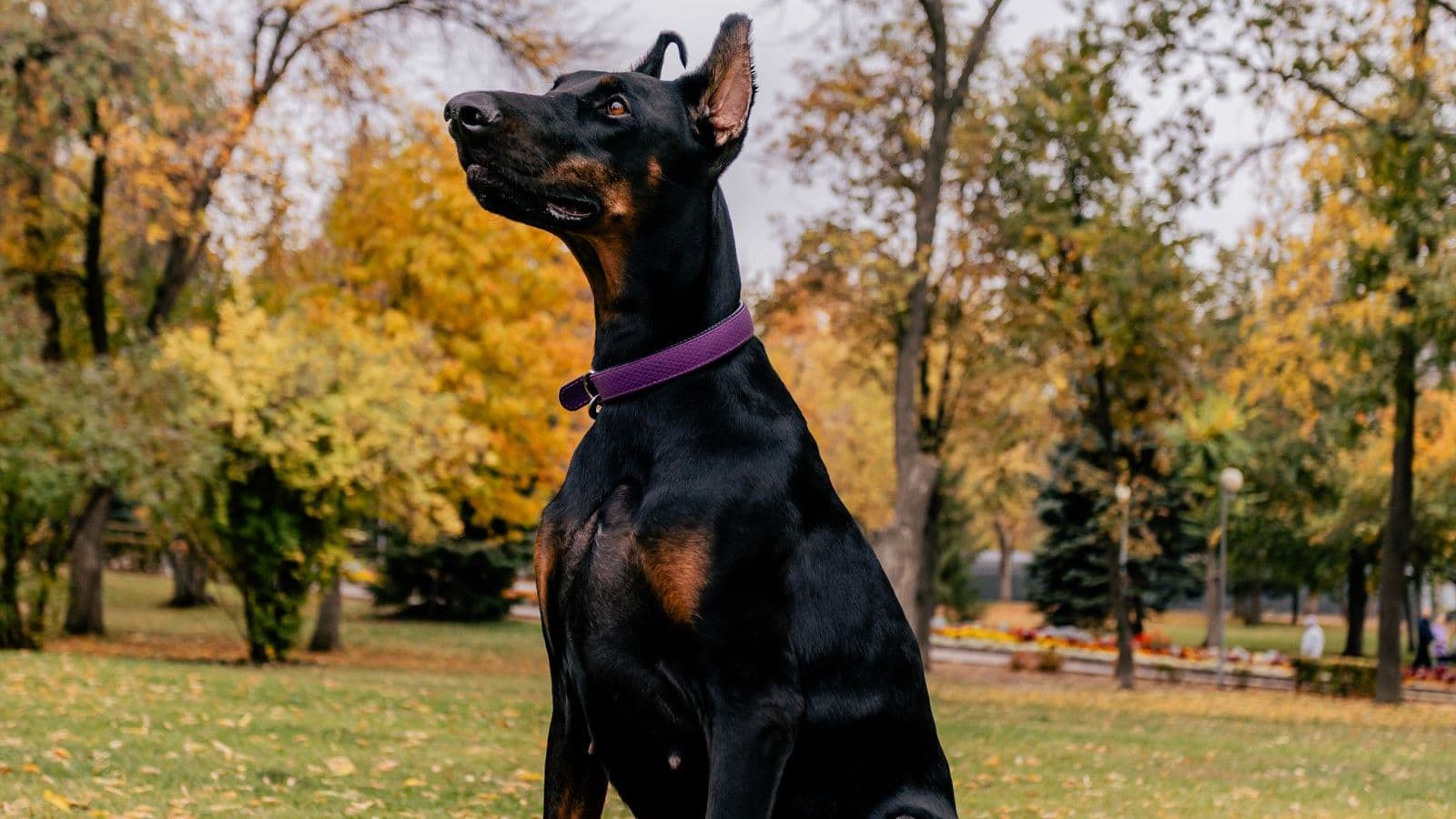
A German tax collector named Karl Dobermann wanted a tough dog to protect him on dangerous rounds in the 1890s. So he made one, mixing breeds for smarts, loyalty, and a protective streak. The result is one of the smartest, most trainable breeds alive. Canine researcher Stanley Coren ranks it #5. It also bonds more closely with its owner than almost any other breed.
People call the modern Doberman a "velcro dog" because it always wants to be near you. That shapes everything about training this breed. A well-trained Doberman is amazing: quick to respond, loyal, and steady. A poorly trained or under-socialized one can grow real anxiety or reactivity. Those are serious problems in a dog this capable.
At a glance:
- Trainability: 10/10, ranked #5 smartest breed by Stanley Coren
- Biggest risk factor: separation anxiety, the "velcro dog" reputation is genetic
- Learning speed: under 5 repetitions per command, bad habits install just as fast
- Example: leave a Doberman alone with no independence training and it can start showing distress within minutes, not hours
- Not for: owners who can't offer real independence training from day one
What Makes Training a Doberman Different
1. Very high intelligence. A Doberman learns most commands in under 5 tries and gets it right on the first command 95% of the time. That makes training fast. But it also means bad habits stick just as fast. Stay more consistent than your dog is clever.
2. A velcro dog with real separation worries. This breed bonds hard and can develop separation anxiety. Start independence training on day one. Skip it, and you end up with an adult dog that cannot be left alone.
3. Sensitive under that tough look. Dobermans read your mood and tone closely. Harsh methods hurt them fast. This breed does best with positive rewards and a strong bond with you.
4. A protective streak that needs guidance. Bred to protect, Dobermans stay naturally watchful. Real socialization builds a dog that protects only when it truly matters. Skip that step, and you get reactivity instead.
Are Dobermans Easy to Train ?
Yes, elite-level. The Doberman scores a perfect 10/10 on our trainability index : one of the smartest, most handler-focused breeds alive, learning new cues in under five repetitions.
- What is easy : everything academic, obedience, tasks, advanced chains, the Doberman was literally engineered for trainability.
- What takes work : socialization (essential for a protective breed) and companionship, this velcro dog needs independence training early and a household that is actually around.
- The catch : the speed cuts both ways, bad habits install in five repetitions too. Be more consistent than the dog is clever.
For an engaged owner, there is no more rewarding student. For a busy household, the attachment needs are the real question.
Week-by-Week Training Plan for Your Doberman
Weeks 1 and 2 : Foundation, Socialization, and Independence
Three priorities run in parallel for this breed: engagement, heavy socialization, and independence training.
- 5-minute sessions, 3-4 times per day.
- Name recognition and eye-contact work, the breed picks this up fast.
- Heavy socialization during the critical window: people, dogs, environments, sounds.
- Independence training: short periods of calm alone time, gradually extended, to prevent separation anxiety.
Weeks 3 and 4 : Core Commands
Dobermans learn core obedience almost instantly. Focus on precision and proofing.
- Sit, down: 2-3 reps each. Add verbal cues immediately.
- Stay: start at 5 seconds, build to 1-2 minutes. The breed has good natural impulse control.
- Add hand signals. Dobermans read visual cues as fast as verbal ones.
Weeks 5 and 6 : Loose Leash and Counter-Conditioning
Dobermans are powerful and athletic. Leash training plus early reactivity prevention is the focus.
- Stop-and-stand method, installs quickly because the breed is so responsive.
- Front-clip harness for everyday walks until skills are solid.
- Counter-conditioning: reward calm responses to other dogs and strangers at threshold distance. The breed's watchfulness can become reactivity without this work. See our reactivity guide.
Weeks 7 and 8 : Recall
Dobermans have excellent recall potential because of their handler focus.
- Train in low-distraction first.
- High-value rewards, vary between food and play.
- 30-foot long line for 6 weeks before off-leash.
- Never use the recall word for negatives.
By week 12, expect 90% reliability in moderate distractions. The breed often achieves near-perfect off-leash recall by 18 months.
Weeks 9 and 10 : Place Training and Settling
Velcro dogs need to learn that being calm and separate is okay. Place training is essential.
- Teach settle on a designated mat or bed.
- Build duration from 30 seconds to 30 minutes.
- Practice the dog settling while you move around, leave the room briefly, return. This builds the independence that prevents separation anxiety.
Weeks 11 and 12 : Generalization
Take everything into public:
- Loose-leash walking past significant distractions
- Recall in fenced areas
- Settle at cafés and busy locations
- Calm, neutral responses to strangers
A trained Doberman is one of the most capable companions in the dog world. The investment in early training pays off enormously.
Common Doberman Training Mistakes
Mistake 1 : Not addressing separation anxiety early. The velcro temperament becomes a serious problem without independence training from day one.
Mistake 2 : Under-socializing. A capable, intelligent, protective breed that's under-socialized can develop serious reactivity. Heavy socialization in the critical window is non-negotiable.
Mistake 3 : Using harsh methods. The breed is sensitive. Corrections damage the handler relationship the Doberman needs to thrive.
Mistake 4 : Encouraging guarding behaviors. Reinforcing suspicion of strangers creates an unstable dog. Reinforce calm neutrality. Full breakdown: Doberman training mistakes.
Frequently Asked Questions
Are Dobermans hard to train ? No, they're among the easiest breeds to teach commands, ranked #5 in intelligence. The challenge is meeting their needs: heavy exercise, mental work, social connection, and early socialization. The training itself is fast.
Are Dobermans dangerous ? Properly bred and raised Dobermans are stable, devoted family dogs. The breed's protective reputation comes from its history and appearance, not from inherent aggression. Aggression results from poor breeding, under-socialization, or mishandling. A well-raised Doberman is calm and discerning.
Why does my Doberman follow me everywhere ? The velcro temperament is genetic. The breed was bred to stay close to its handler. This is normal and usually endearing, but it requires independence training to prevent separation anxiety. Teach the dog that calm alone time is safe and normal.
How much exercise does a Doberman need ? 60-90 minutes of vigorous daily exercise plus 20+ minutes of mental work. The breed is athletic and intelligent, needing both physical and cognitive challenge. Under-stimulated Dobermans develop anxiety and destructive behaviors.
Can I leave a Doberman alone during the workday ? Only with early, consistent independence training and adequate exercise. The breed's separation sensitivity means many Dobermans struggle with long alone periods. Doggy daycare, dog walkers, or work-from-home arrangements suit the breed better. Crate training and gradual alone-time conditioning help.
Is positive reinforcement effective for Dobermans ? Yes, ideal for the breed. Their intelligence and sensitivity make reward-based training fast and effective. Modern protection-sport and working Doberman training has shifted heavily toward positive methods. Harsh techniques damage the breed's sensitive temperament.
When should I start training my Doberman puppy ? Day one, at 8 weeks. The breed's intelligence means they start learning immediately, for better or worse. Early socialization (8-16 weeks) and independence training are especially critical for this breed.
Why TailorPup Was Built for Dobermans
A generic plan doesn't account for the separation sensitivity, the rapid learning that installs bad habits fast, or the socialization needs of a capable protective breed. TailorPup's Doberman plan front-loads independence training and socialization, builds counter-conditioning early, and leverages the breed's intelligence with advanced skills.
Daily 12-minute sessions, weekly adjustments. Plans from $9.99/month, no trial; annual starts at $2 for 7 days. Cancel anytime.
Related: Doberman Training Mistakes · Reactivity Training · Recall Training · Leash Pulling