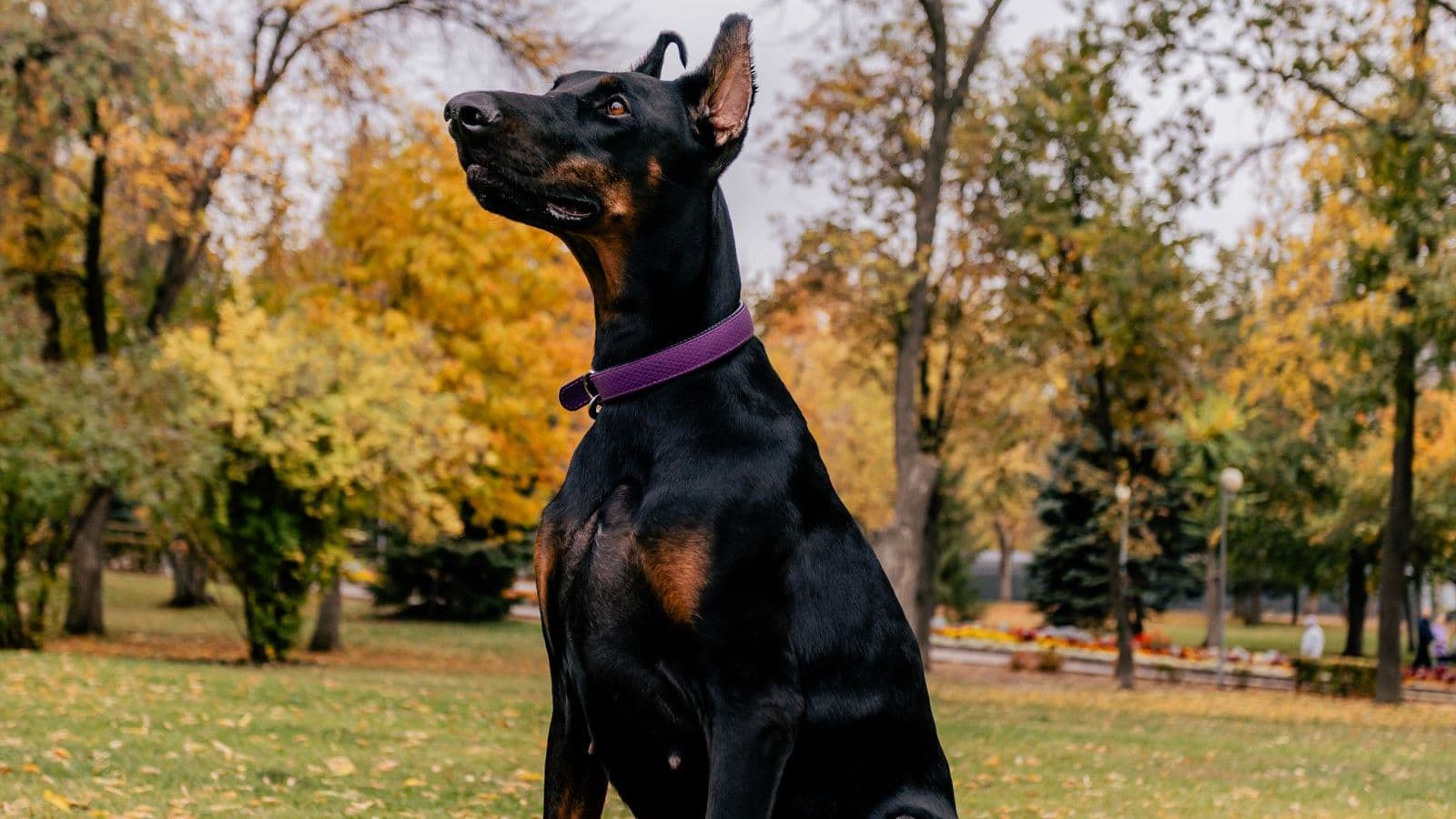
The Doberman is among the smartest, most trainable breeds in the world, routinely ranked in the top five for canine intelligence. That is a double-edged inheritance : the same brain that learns a new cue in four repetitions learns a bad habit just as fast, and the same intense bond that makes the breed magnificent makes it fragile to certain mistakes.
The anxious, reactive Dobermans that feed the breed's undeserved reputation are almost never born that way. They are produced, by eight specific, predictable errors. Here they are, why they hit this breed harder than most, and what modern working-dog handlers do instead.
1. Ignoring separation anxiety until it is severe
Dobermans are the archetypal "velcro dog" : they bond intensely to their people and are genetically prone to separation distress. Owners who skip independence training often end up with adult Dobermans who panic, destroy door frames, or self-harm when left alone, and a 90-pound panicking dog does real damage, to the house and to itself. Prevention is straightforward if you start in week one :
- Short, calm alone-time sessions behind a gate, extended gradually.
- A high-value chew that only exists during alone time.
- Absences kept below the distress threshold while the skill builds.
- Boring departures and boring returns, no ceremonies at the door.
Treatment of established separation anxiety in this breed is long, hard, and sometimes needs professional and medical support. Prevention costs ten minutes a day.
2. Under-socializing a capable protective breed
A Doberman is intelligent, athletic, physically formidable, and bred with protective instincts. Well-socialized, that package becomes a stable, discerning adult that can tell a mail carrier from a threat. Under-socialized, it becomes reactivity and fear-based defensiveness, which is a serious problem in a dog this capable. Heavy socialization during the 8-to-16-week window is non-negotiable : varied people, calm dogs, environments, sounds, surfaces, and handling, all banked as positive experiences.
Continue deliberately through adolescence. With protection breeds there is no neutral ground, the exposure you skip becomes the suspicion you manage for a decade.
3. Using harsh, dominance-based methods
Old-school Doberman training leaned on corrections, prong collars, and dominance theater, and the results are why the old stereotype exists. The modern breed is emotionally sensitive under the armor plating : harsh methods produce anxious, shut-down, or fear-reactive Dobermans, the exact failure modes owners fear most. It is telling that serious working and protection-sport Doberman handlers have shifted heavily toward positive reinforcement, not out of softness, but because it produces more reliable, more stable, more precise dogs.
If a trainer's first suggestion for your Doberman is a prong collar, keep looking. The breed gives everything to a handler it trusts and very little to one it fears.
4. Encouraging guarding behaviors
Owners who praise their Doberman for barking at strangers, growling at visitors, or "protecting" the living room are manufacturing an unstable adult. Here is the thing that surprises new owners : a well-bred Doberman needs zero encouragement to protect, the discernment is factory-installed and switches on when a genuine threat exists. What you must train is the opposite skill, calm neutrality toward normal life : delivery drivers, guests, kids on bikes, weird hats. Reward relaxed observation, orchestrate friendly visitor arrivals, and let the breed's natural judgment do the rest. A Doberman that alerts at everything protects you from nothing.
5. Letting the intelligence work against you
Dobermans learn in fewer than five repetitions, and the dog does not distinguish curriculum from accident. Jump on the couch twice with no consequence : couch access installed. Counter-surf once successfully : counter patrol installed. Beg at the table one lucky evening : begging installed. Owners who are inconsistent, allowing a behavior on tired days and forbidding it on strict ones, hand the smartest breed in the room a spreadsheet of exploitable gaps. The rule with a Doberman is simple and demanding : decide the household rules before the dog arrives, and be more consistent than the dog is clever. It is a high bar. Clear it anyway.
6. Insufficient mental work
A Doberman's brain demands a daily workload, this is a breed built to solve problems next to a human all day. Without mental challenge, the breed reliably develops anxiety, obsessive habits, and destructive projects, even when physical exercise is generous. Running the body while idling the brain is half a program. Budget 20 or more minutes daily of real cognitive work :
- Training sessions that teach genuinely new skills, not just reruns.
- Scent games and find-it searches around the house.
- Puzzle feeders and food-dispensing work.
- Advanced skill chains, the breed thrives on complexity.
A mentally worked Doberman is calm in a way no amount of running produces.
7. Long daily isolation
The velcro temperament is not negotiable equipment. Even with excellent independence training, Dobermans genuinely struggle with long, routine isolation, a dog alone nine or ten hours a day, every day, is being asked to live against its own design. This breed suits work-from-home owners, households where someone is usually around, or families willing to arrange daycare and midday visits. Be honest about this before choosing the breed, because no training plan fully patches a lifestyle mismatch, and the failure mode (severe separation distress in a powerful dog) is expensive in every sense.
8. Coasting because the puppy "seems easy"
Doberman puppies are smart, biddable, and often eerily well-behaved, which convinces owners that formal training is optional. Then adolescence arrives, roughly 10 to 18 months, hormones and boundary-testing in a now full-sized athlete, and every manner that was never actually installed becomes a problem with 80 pounds behind it. The easy puppy is the trap. Train consistently from week one anyway : short daily sessions, manners as non-negotiables, impulse control as a curriculum. The owners who do this sail through adolescence. The owners who coasted meet their first real Doberman challenge exactly when the dog is strongest.
What works with Dobermans
Front-load independence training and socialization, train exclusively with reward-based methods, feed the brain daily, hold consistent rules, respect the breed's need for companionship, and never outsource to harshness what should be built with trust.
What ties all eight mistakes together is the breed's emotional sensitivity. A Doberman reads your state and returns what it is given : calm, connected handling produces a focused, devoted, discerning dog; harshness and neglect produce anxiety in an athlete's body. Meet the needs, and you have one of the finest companion dogs on earth, which is exactly what the breed was designed to be.
TailorPup's Doberman plan front-loads independence work and socialization in the first weeks, builds counter-conditioning early, and leverages the breed's intelligence with advancing skill chains, all on reward-based methods.
Frequently Asked Questions
Are Dobermans easy to train?
Extremely, they rank in the top five breeds for working intelligence and learn new cues in a handful of repetitions. The challenge is not teaching, it is consistency : the same brain learns your bad habits as fast as your curriculum.
Do Dobermans have separation anxiety?
The predisposition is real and strong, velcro bonding is part of the breed. Independence training from week one prevents most cases. A Doberman routinely alone 9 or more hours a day is a poor fit no matter the training.
Should I train my Doberman to be protective?
No. A well-bred Doberman needs no protection training to guard its family, the discernment is innate. Deliberately encouraging suspicion creates instability. Train calm neutrality toward normal life and let the natural judgment handle the rest.
When do Dobermans calm down?
Most settle meaningfully around 2 to 3 years. Adolescence (10 to 18 months) is the demanding stretch, which is precisely when consistent training from puppyhood pays off.
Start your Doberman's plan at tailorpup.com →
Related: How to Train a Doberman Pinscher · Reactivity Training · Recall Training