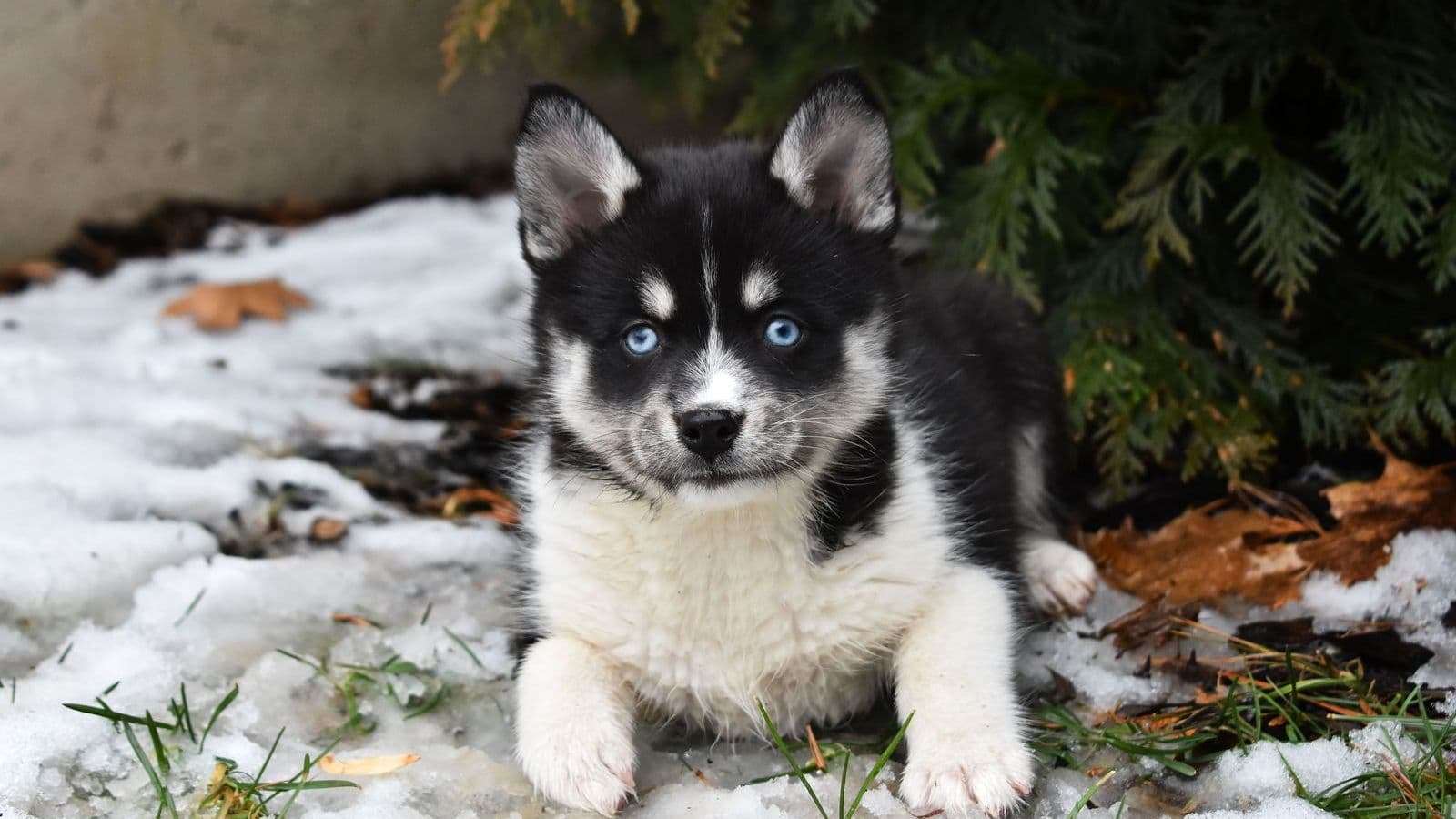
A Husky mother and a Pomeranian father, bred by artificial insemination because of the size gap between them, that's how a Pomsky comes to exist. The result went viral in the 2010s for its looks: a small-to-medium dog with a Husky's striking eyes and coloring under a fluffier coat, usually 5-15kg depending on the litter.
But looks aren't what surprises new owners. Temperament is. From the Husky side comes real independence, a serious talent for escape, and a chatty, vocal nature. From the Pomeranian side comes watchfulness, confidence, and a readiness to bark. Both parent breeds are famously hard to train, for different reasons, so a Pomsky can go either way. No two are quite the same.
This is a charming, demanding dog. Its independence means it cooperates for real rewards, not because you asked nicely. Its escape talent, inherited from one of the best escape artists in the dog world, makes secure containment non-negotiable. It's often vocal from both sides of its family. And that small body hides real energy. Verify your fencing, manage the barking early, work patiently on recall, and stick to reward-based training, and the Pomsky becomes a striking, devoted companion.
At a glance:
- Trainability: 7/10, cooperates for real rewards, not automatic obedience
- Biggest risk factor: escape ability, inherited from one of the best escape artists in dogs
- Noise level: often vocal from both parent breeds, howling, talking, and alert barking
- Example: a Pomsky left in an untested yard will often dig under or squeeze through a gap most dogs would ignore
- Not for: owners who can't verify secure fencing before day one
What Makes Training a Pomsky Different
1. Husky independence meets Pomeranian confidence. Neither parent breed is eager to comply just because you asked. Training has to build real value through rewards. Don't expect automatic deference.
2. A genuine escape talent. The Siberian Husky is one of the best escape artists of any breed, and a Pomsky with strong Husky genes will dig, climb, or push through gates. Verify your containment. Don't assume it.
3. Double vocal genes. Huskies howl and "talk." Pomeranians bark at anything new. A Pomsky often inherits both. Teach a "quiet" cue early, it handles both the alert barking and the excitement noise.
4. Real energy, small body. Don't let the size fool you, the Husky heritage brings genuine energy. Without a real daily outlet, a Pomsky gets loud and destructive fast.
Week-by-Week Training Plan for Your Pomsky
Weeks 1 and 2 : Containment Check and Foundation
Verify containment before anything else, and begin engagement and a "quiet" cue. Our puppy basics guide covers the mechanics.
- Verify yard security: dig guards at the fence base, secure gates, no climb points.
- Begin a "quiet" cue and pair short sessions with high-value food.
- Socialize broadly with people, dogs, surfaces, and sounds.
- Reward voluntary attention to build engagement.
Weeks 3 and 4 : Core Commands, Ask Once
Sit, down, and stay come with consistent, reward-based handling.
- Lure the behaviors and reward the instant they happen.
- Ask once, wait, and reward rather than repeating, which teaches the cue is optional.
- Keep sessions short, varied, and rewarding for an independent mind.
Weeks 5 and 6 : Leash and Barking Management
Install leash manners and proof the "quiet" cue.
- Use a Y-harness and the stop-and-stand method for loose-leash walking.
- Apply "quiet" to address both alert barking and excitement vocalizations.
- Reward calm, settled behavior over vocalizing.
Weeks 7 and 8 : Recall, Long-Term Investment
Build recall against the Husky roaming and escape drive.
- Train recall on a long line in a securely fenced area, paying extravagantly.
- The Husky escape and roaming tendency makes reliability a multi-month project.
- Reserve off-leash freedom for secure, fenced areas only.
Weeks 9 and 10 : Public Manners
Build polite behavior in public.
- Practice loose-leash walking in progressively busier environments.
- Reward four-on-the-floor greetings rather than jumping.
- Reward focus on you around distractions.
Weeks 11 and 12 : Trick Training and Ongoing Challenge
Engage the intelligent mind and provide ongoing mental work.
- Teach trick chains, which the Pomsky's intelligence enjoys.
- Use puzzle feeders and games to provide the mental exercise that reduces boredom-driven vocalizing.
- Establish a sustainable rhythm of exercise, enrichment, and training.
Common Pomsky Training Mistakes
Mistake 1 : Trusting yard containment without verification. The Husky escape tendency is real in many Pomskies. A dog that can dig under a fence will do so.
Mistake 2 : Allowing vocal behavior without management. Both parents contribute to a very vocal dog. Shape quiet from puppyhood.
Mistake 3 : Giving up on recall because the dog is small. A Pomsky that does not recall can be hit by a car. Invest on a long line.
Mistake 4 : Making size-based exceptions. Hold consistent rules to prevent small dog syndrome. Full breakdown : Pomsky training mistakes.
Frequently Asked Questions
Are Pomskies easy to train ? Moderate to hard. Both parent breeds are independent, so a Pomsky cooperates for real rewards, not eager obedience. Stay consistent and patient and they learn well. The escape talent, the noise, and the energy make this more demanding than the cute photos suggest.
How big do Pomskies get ? Usually 5-15kg and 25-38cm tall, but it varies a lot by generation (F1, F1b, F2) and by the actual parents. You can't predict adult size precisely.
Are Pomskies good apartment dogs ? With real exercise and active bark management, yes. Without those, the double vocal inheritance makes them a tough neighbor. A solid "quiet" cue and a tired dog make close quarters work.
How much exercise does a Pomsky need ? 45 to 60 minutes of real activity a day, plus mental work. The Husky side brings genuine energy despite the small body. Skip the exercise and you get a loud, destructive dog.
Do Pomskies shed a lot ? Yes, a lot, with a heavy seasonal blowout inherited from both parents. Regular brushing handles the daily shedding. The seasonal coat change needs more.
Are Pomskies good with children ? With socialization and size-appropriate handling, yes, lively and affectionate. The small size makes rough handling risky, so supervise time with young kids.
How long do Pomskies live ? 13 to 15 years typically, generally a sturdy little dog. A good breeder health-tests both parent breeds for eye, hip, and patella issues.
Why TailorPup Was Built for Pomskies
A generic plan does not account for the Husky's escape-awareness requirements, the double vocal inheritance, or the independence combination of both parent breeds. TailorPup's Pomsky plan front-loads containment verification and bark management, builds recall against the roaming drive, and uses the consistent, reward-based handling this striking but demanding cross requires.
Daily 12-minute training sessions plus weekly adjustments. Plans from $9.99/month, no trial; annual starts at $2 for 7 days. Cancel anytime.
Related: Pomsky Training Mistakes · Barking Solutions · Recall Training · Puppy Training Basics