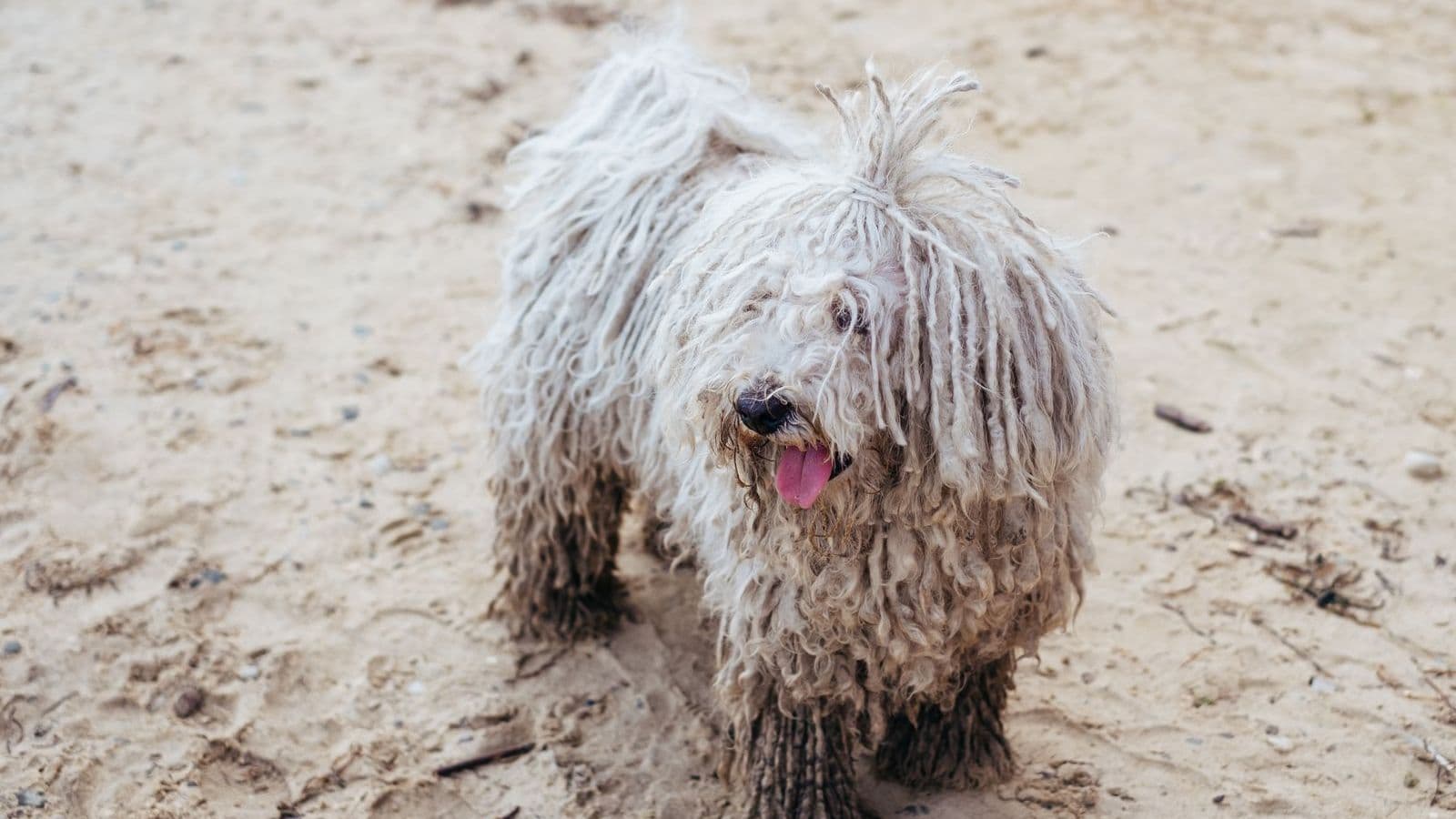
The Komondor is the unmistakable corded "mop dog" of Hungary, a large, white livestock guardian whose dense coat naturally forms long cords that once let it blend in among the sheep it protected and shrug off the bite of a wolf. For centuries it lived out among the flocks, guarding them independently against predators and thieves, and that ancient job defined the breed completely. The Komondor is calm, devoted, and dignified with its family, and serious, territorial, and protective by nature. It is one of the most striking dogs in the world and one of the least suited to a casual home.
Training a Komondor means understanding that it was bred to think for itself, not to obey. Like other livestock guardians, it evaluates situations and acts on its own judgment, so reliable, snappy obedience is genuinely unrealistic, and treating that as failure misreads the breed. What it needs instead is heavy, lifelong socialization, calm and respectful leadership, secure containment, and an experienced owner with realistic expectations. Get those right and the Komondor is a magnificent, trustworthy guardian. Get them wrong, and you have an enormous, powerful, protective dog with serious problems. This is not a first dog.
This guide covers what works with a Komondor, week by week, written for a committed, experienced owner.
At a glance:
- Trainability: 5/10, considers requests rather than obeying on reflex
- Biggest risk factor: an independent guardian mind that frequently declines commands that seem pointless to it
- Temperament: serious, territorial, and protective, needing heavy, lifelong socialization
- Example: Asked to come inside mid-patrol, the Komondor may simply ignore the cue if it sees no reason to comply.
- Not for: first-time owners or casual households without secure containment
What Makes Training a Komondor Different
Four breed traits shape your approach.
1. An independent guardian mind. The Komondor was selected for centuries to make its own decisions out with the flock, so it considers requests rather than obeying on reflex, and frequently declines the ones that seem pointless to it. This is the breed's nature, not stubbornness, and realistic expectations are the most important thing you bring to training.
2. A powerful protective instinct. The Komondor is intensely territorial and naturally suspicious of strangers and novelty. Heavy, ongoing socialization is what turns that instinct into sound judgment rather than indiscriminate suspicion, which is a serious matter in a dog this size and strength.
3. Calm and low-energy, but immovable. Unlike a herding dog, the Komondor conserves its energy for guarding and is relatively calm and low-exercise. But it is also large and strong-willed, so manners and leash control must be taught early, while the dog is still manageable, because you cannot out-muscle an adult.
4. A demanding corded coat. The signature cords need significant, specialized care, separating as the dog matures, kept clean and dry to avoid mildew and skin problems. Early, positive handling and grooming tolerance are an essential part of raising the breed.
Week-by-Week Training Plan for Your Komondor
Below is the framework we use at TailorPup for a Komondor-specific 12-week plan, written for an experienced owner. The order and emphasis matter more than speed.
Weeks 1 and 2 : Foundation and Intensive Socialization
Socialization is the most important work with a guardian breed, so it leads. Expose the puppy calmly and positively to many people, places, sounds, and well-controlled dogs. Alongside it, build engagement with high-value rewards in three to four short daily sessions, and begin gentle handling for the coat care ahead. Patience is everything; you are building trust.
Weeks 3 and 4 : Core Commands
Lure sit and down, mark, reward generously, and add cues once reliable, expecting partial compliance, which is completely normal for a livestock guardian. Keep sessions short and end on a win. Pushing for crisp, repetitive obedience only frustrates both of you.
Weeks 5 and 6 : Leash Work and Counter-Conditioning
A dog this powerful must learn to walk politely while it is still manageable. Use stop-and-stand for pulling and a front-clip harness for control. Begin counter-conditioning to strangers and dogs so the guardian instinct stays discerning rather than reactive. Our reactivity guide lays out the method.
Weeks 7 and 8 : Recall and Containment
Build recall with jackpot rewards, but plan around the reality that recall will never be fully reliable in this independent guardian. Treat long lines and secure, tall fencing as permanent tools, not training-wheels. Reinforce that coming to you is always worthwhile, while never relying on it for safety.
Weeks 9 and 10 : Settling, Coat Care, and Ongoing Socialization
Teach a solid place or settle behavior, giving a watchful guardian a calm default indoors. Build real tolerance for coat handling as the cords form, and keep socializing, because for guardian breeds this is lifelong. Reward calm, neutral responses to normal comings and goings.
Weeks 11 and 12 : Generalization
Work on manners in more distracting settings, calm responses to strangers, and reliable containment habits. The goal is a stable, well-socialized guardian that is safe and manageable in the situations your life actually involves, not a precision obedience dog.
Common Komondor Training Mistakes
Three mistakes show up repeatedly with this breed.
Mistake 1 : Expecting obedience. Owners who treat the Komondor like a biddable pet are constantly frustrated and often escalate to harshness that backfires. The breed declines requests by design. Adjust your expectations dramatically and reward what you get.
Mistake 2 : Under-socializing the guardian instinct. This is the dangerous one. Without heavy, ongoing socialization, the breed's protectiveness becomes indiscriminate suspicion, a genuine safety problem in a dog this large. Socialization is not optional with a Komondor.
Mistake 3 : Weak containment or harsh handling. The breed is territorial and resents heavy-handed pressure. Secure, tall fencing, long lines, and patient reward-based methods are the only approach that works. The full list is in our Komondor training mistakes guide.
Frequently Asked Questions
Are Komondors good for first-time owners ? No. The size, power, extreme independence, guardian instinct, and demanding coat require experienced ownership and ideally rural or spacious property. The breed is poorly suited to typical pet homes and novice handlers.
Are Komondors trainable ? For basic manners with patience and realistic expectations, to a degree. For reliable, on-demand obedience, no; the breed was bred to guard independently and make its own decisions. That independence is its purpose, not defiance.
Can I let my Komondor off-leash ? Realistically, no. The territorial, independent nature makes recall unreliable in open areas. Secure, tall fencing and long lines are essential parts of owning the breed safely.
How much exercise does a Komondor need ? Relatively little: moderate daily walks plus secure space. Like most livestock guardians, the Komondor conserves energy for watching rather than needing intense exercise, though it still needs daily engagement and structure.
How do I care for the corded coat ? The cords form naturally as the dog matures and must be separated by hand, kept clean, and dried thoroughly to prevent mildew and skin issues. It is significant, specialized work, and building grooming tolerance early is essential.
Is positive reinforcement effective for Komondors ? Yes, and it is the only approach that works. The independent breed ignores or resents harshness, while patient, motivating, reward-based training paired with realistic expectations earns cooperation.
Do Komondors get along with other pets ? Raised with them and properly socialized, often yes, especially with animals they consider part of their flock. But the protective, territorial nature means careful introductions and supervision, particularly with unfamiliar animals.
Why TailorPup Was Built for the Komondor
A generic plan assumes a biddable companion and sets owners up to fail with a breed that was never meant to be one. That mismatch is why standard advice is actively unhelpful for guardian breeds.
TailorPup builds a 12-week plan around your specific dog: its guardian instincts, its age, and the realities of living with it. For a Komondor that means front-loaded intensive socialization, guardian-appropriate motivation, realistic expectations baked into every goal, early manners while the dog is small, and a heavy emphasis on secure containment.
Daily 12-minute sessions plus weekly adjustments based on your dog's progress. Plans from $9.99/month, no trial; annual starts at $2 for 7 days. Cancel anytime.
Related: Komondor Training Mistakes · Reactivity Training · Recall Training · Leash Pulling