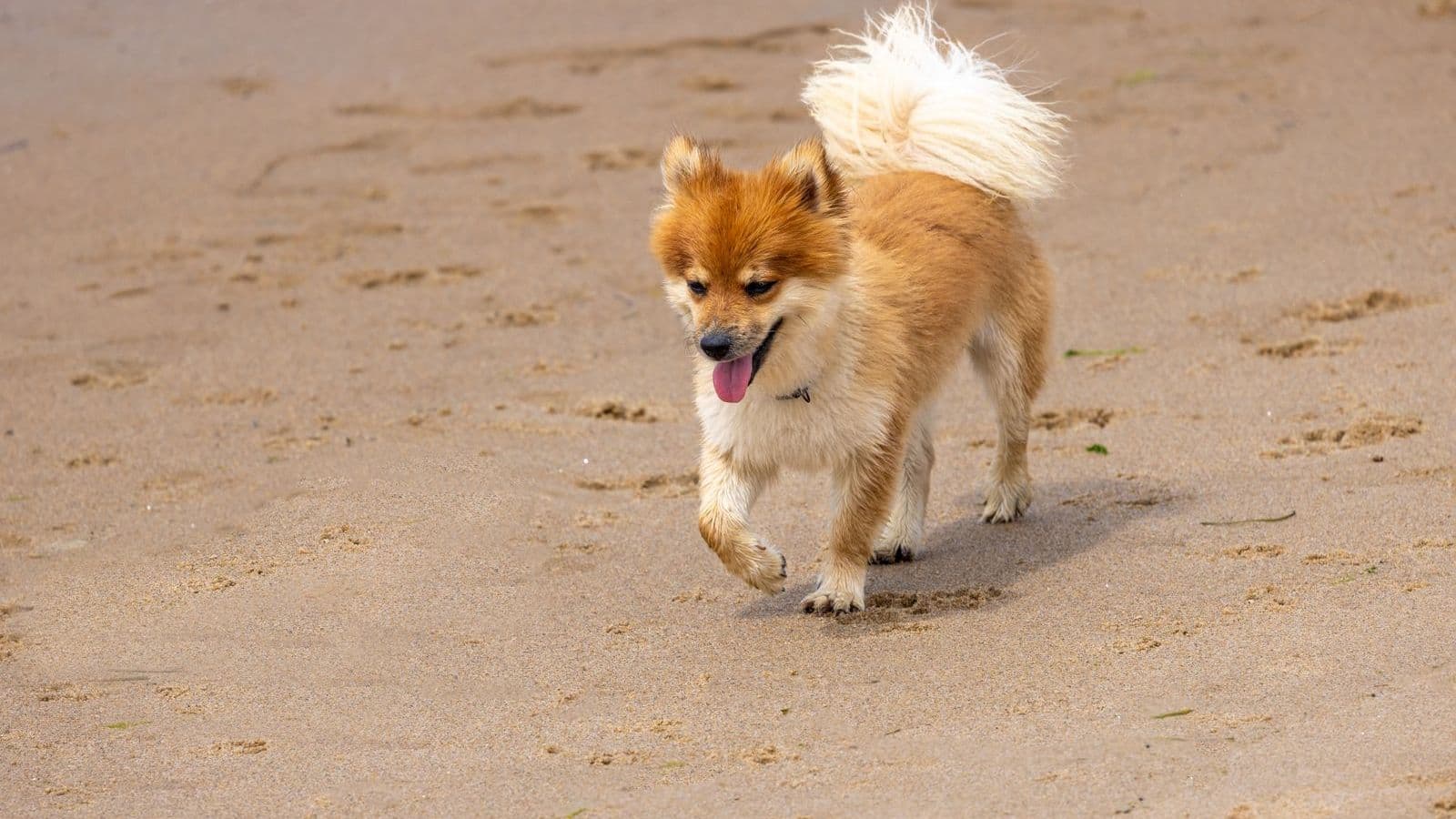
The Icelandic Sheepdog is the only dog breed native to Iceland, brought to the island by Viking settlers around 870 AD and shaped over the following millennium into a hardy, versatile herder perfectly suited to Iceland's terrain. It worked sheep across volcanic highlands and steep slopes, drove them down from summer pasture, prevented them falling on dangerous ground, and, most distinctively, alerted the farmer to anything amiss with its voice. Barking, herding, and cheerful watchfulness are not behaviors to be trained into an Icelandic Sheepdog; they are the breed's entire reason for existing.
Weighing 9-14 kg, with a thick double coat, a curled tail, and an irrepressibly happy expression, the Icelandic Sheepdog is one of the most extroverted and joyful of all working dogs. It is famous for its smiling, tail-wagging friendliness and its sheer enthusiasm for life and people. It is also, by direct consequence of its herding job, one of the more vocal small-to-medium breeds.
None of this makes the Icelandic Sheepdog difficult, it is sociable, biddable, and eager to please by Nordic-breed standards, but it does mean that anyone hoping for a quiet, low-energy companion has the wrong dog. Training is about meeting the breed's energy, channeling its herding drive, and managing the barking before it becomes a fixed habit.
It helps to understand how isolated this breed's development really was. For roughly a thousand years the Icelandic Sheepdog evolved on a remote North Atlantic island with almost no outside canine influence, shaped entirely by the demands of Icelandic farming and the harsh environment. Iceland even banned the import of dogs for long stretches to protect against disease, which kept the gene pool closed and the working type pure.
The result is a remarkably consistent, functional, and healthy breed whose every trait, the weatherproof double coat, the cheerful resilience, the herding initiative, and yes, the ready voice, traces directly to a job done in a specific place.
Knowing this reframes the barking in particular: it is not a behavioral defect or a sign of anxiety but a thousand-year-old feature, as deliberately bred as the coat. That does not mean you must tolerate non-stop noise; it means the goal is to manage and direct an instinct rather than to eliminate something the dog was fundamentally built to do.
At a glance:
- Trainability: 8/10, biddable and eager to please by Nordic-breed standards
- Biggest risk factor: the alerting bark becoming a fixed habit if not addressed early
- Herding instinct: independent herding decisions carry over at home, so it will try to herd children, pets, and movement
- Example: A visitor walks up the driveway. Without an early "quiet" cue, the dog announces it loudly and repeatedly.
- Not for: owners hoping for a quiet, low-energy companion
What Makes Training an Icelandic Sheepdog Different
1. It was bred to bark. The Icelandic Sheepdog's alerting bark was its primary communication tool, and the breed uses its voice freely at approaching animals, moving objects, visitors, and anything novel. The habit forms quickly and is hard to undo later, so a "quiet" cue is the very first priority.
2. Independent herding instinct. The breed made herding decisions on its own across difficult terrain, and that initiative carries home, it will try to herd children, pets, and movement. Consistent redirection to appropriate outlets keeps the instinct productive.
3. Social, joyful, and high-energy. This is not an anxious or difficult breed; it is simply enthusiastic and energetic. It needs real daily exercise and engagement, and it gives back warmth, playfulness, and devotion in return.
4. Spitz independence with biddability. Like all Nordic spitz breeds the Icelandic Sheepdog has a streak of independence, but it is notably more handler-oriented and willing than most of its relatives, which makes reward-based training genuinely effective.
Week-by-Week Training Plan for Your Icelandic Sheepdog
Weeks 1 and 2 : Bark Management From Day One
Install a "quiet" cue immediately and socialize broadly; the bark habit forms fast in this breed. Our puppy basics guide covers the mechanics.
- Begin "quiet" work in week one at windows and doors.
- Socialize broadly to reduce the number of things worth barking at.
- Pair short, upbeat sessions with high-value food.
- Reward calm, settled behavior generously.
Weeks 3 and 4 : Core Commands
The breed learns quickly with food motivation and enthusiasm.
- Teach sit, down, stay, and leave it.
- Keep sessions short, varied, and fun.
- Reward engagement and check-ins.
Weeks 5 and 6 : Loose Leash and Herding Redirect
Install leash manners and channel the herding instinct.
- Use a Y-harness and the stop-and-stand method.
- Reward every step on a slack leash.
- Redirect herding of children or pets to a toy or task.
Weeks 7 and 8 : Recall
Build a reliable recall against the breed's independence.
- Train recall on a long line with high-value rewards.
- Proof recall around movement and other animals.
- Keep recall always rewarding, never a precursor to something unpleasant.
Weeks 9 and 10 : Sport Introduction
Give the energetic mind a job.
- Introduce agility, treibball, or herding instinct tests.
- Reward enthusiastic, controlled work.
- Vary activities to keep the cheerful mind engaged.
Weeks 11 and 12 : Ongoing Challenge and Proofing
Lock in the foundations and commit to ongoing engagement.
- Proof all cues, including "quiet," in busy environments.
- Keep introducing new skills and sport progressions.
- Establish a sustainable weekly rhythm of exercise plus mental work.
Common Icelandic Sheepdog Training Mistakes
Mistake 1 : Allowing alert barking. The breed barks by design, and the habit sets fast. Install a "quiet" cue from week one.
Mistake 2 : Expecting a calm companion. The Icelandic Sheepdog is full of energy and enthusiasm, a feature to manage, not a flaw to suppress.
Mistake 3 : Under-exercising. The breed needs sixty minutes of vigorous daily activity plus mental work to stay balanced.
Mistake 4 : Allowing herding of family. Redirect the instinct toward play and structured work. Full breakdown : Icelandic Sheepdog training mistakes.
Frequently Asked Questions
Are Icelandic Sheepdogs easy to train ? Yes, they are enthusiastic, food-motivated, and more biddable than most Nordic breeds. The main work is managing the natural barking and channeling the herding drive, not overcoming reluctance to learn.
Are Icelandic Sheepdogs good family dogs ? Excellent. Their joyful, sociable nature makes them wonderful, affectionate family companions, generally good with children and other pets. They thrive on being included in family life.
Are Icelandic Sheepdogs good apartment dogs ? With adequate exercise and active bark management, manageable, though the vocal tendency makes close-quarters living a challenge. A "quiet" cue and a tired dog are essential.
Do Icelandic Sheepdogs bark a lot ? Yes, by heritage, alerting was their job. With early, consistent "quiet" training and enough stimulation, the barking stays reasonable, but it will never be a naturally silent breed.
Are Icelandic Sheepdogs hypoallergenic ? No. The thick double coat sheds significantly, especially during seasonal blows, and needs regular brushing.
Are Icelandic Sheepdogs rare ? Outside Iceland and Scandinavia, moderately uncommon, though dedicated breeders exist internationally. The breed nearly went extinct twice and remains carefully managed.
How long do Icelandic Sheepdogs live ? Typically twelve to fourteen years, with good general hardiness for a Nordic working breed.
Why TailorPup Was Built for Icelandic Sheepdogs
A generic plan designed for calm companion dogs treats the breed's barking and energy as problems rather than the working heritage they are, and it offers no real strategy for either. TailorPup's Icelandic Sheepdog plan takes the vocal, energetic, joyful working character seriously, builds bark management in from week one, and channels the herding drive into a job, so the cheerful companion the breed should be actually emerges.
Daily 12-minute training sessions plus weekly adjustments. Plans from $9.99/month, no trial; annual starts at $2 for 7 days. Cancel anytime.
Related: Icelandic Sheepdog Training Mistakes · Barking Solutions · Recall Training · Puppy Training Basics