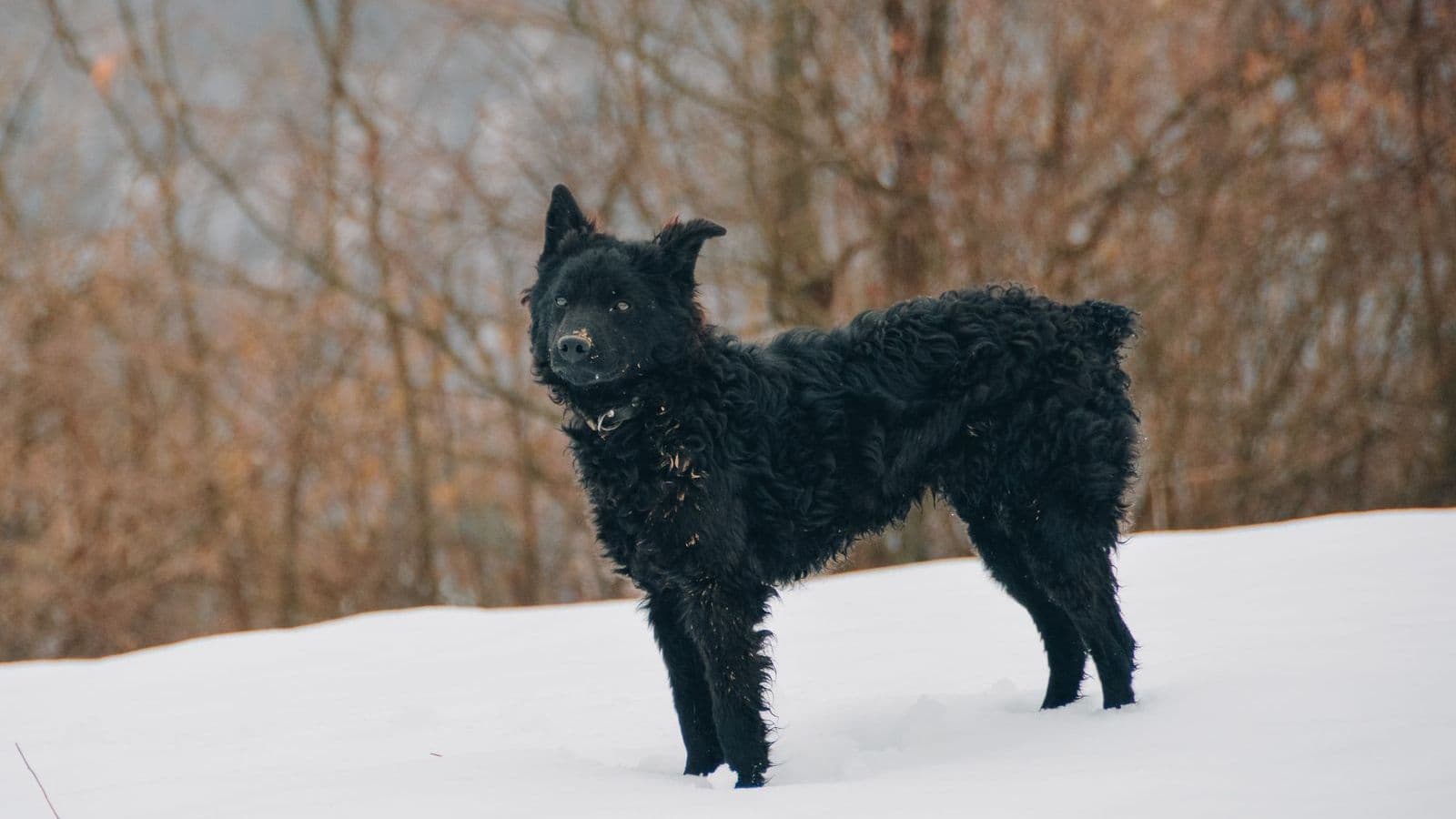
The Croatian Sheepdog (Hrvatski Ovčar) is Croatia's only native dog breed, and a strikingly old one, Bishop Petar Bakić documented it in 1374 as the Canis pastoralis croaticus, describing a black, medium-sized herding dog almost identical to the one bred today. It developed in the continental plains of Croatia, especially around Slavonia, to drive cattle and sheep across open farmland, and it survived into the modern era thanks to a deliberate preservation program begun in the twentieth century by Croatian veterinarian Stjepan Romić.
Weighing 13-20 kg, with a distinctive black, wavy-to-curly coat and a quick, fox-like face, the Croatian Sheepdog is an agile, lively, intensely intelligent worker. Among herding breeds it sits near the top for raw trainability, it learns fast, retains well, and genuinely enjoys working with its person, which makes it a joy for an engaged owner. The flip side of that quick mind is a low tolerance for boredom and a strong, vocal alertness inherited from its watchdog role.
A Croatian Sheepdog given a job, daily exercise, and early bark management becomes a brilliant, devoted partner; one left under-stimulated invents its own noisy, busy agenda. Training is mostly a matter of keeping up with the dog.
What makes the Croatian Sheepdog such a satisfying breed to train is the speed of the feedback loop. Where a guardian breed might take weeks to reveal whether a lesson has landed, this dog tells you within a session or two, it grasps a new cue quickly, offers behaviors eagerly, and visibly enjoys the problem-solving. That responsiveness is enormously motivating for an owner, and it opens the door to advanced work that many herding breeds reach only slowly: complex trick chains, agility sequences, distance control, and genuine off-leash reliability.
The same quickness, though, means the dog learns unintended lessons just as fast, so sloppy timing or accidentally rewarded barking sets habits in a hurry. The breed essentially mirrors the quality of its training back at you, magnified. Owners who bring consistency and a little creativity are rewarded with one of the brightest, most willing partners in the herding group; those who train carelessly find the same intelligence working against them.
At a glance:
- Trainability: 8/10, one of the more trainable herding breeds, quick to learn and eager to work
- Biggest risk factor: persistent alert barking from its watchdog heritage, sets in fast without early "quiet" training
- Bonding style: active herding instinct, will try to organize children, pets, and moving objects
- Example: Left under-stimulated, the dog invents its own noisy, busy agenda instead of settling.
- Not for: owners who can't provide sixty minutes of vigorous daily activity plus mental work, or noise-sensitive households
What Makes Training a Croatian Sheepdog Different
1. Very high intelligence and trainability. This is one of the more trainable herding breeds, quick to learn, eager to work, and strongly food-motivated. The challenge is rarely getting the dog to understand a cue; it is keeping the fast mind engaged and channeling its enthusiasm productively.
2. Active herding instinct in a compact body. The breed has functional herding drive and will try to organize children, pets, and moving objects. Consistent redirection to appropriate activities from the first occurrence keeps the instinct from becoming a nuisance.
3. Alert and vocal. The Croatian Sheepdog's watchdog heritage produces a quick, persistent alert bark. A "quiet" cue installed in the first week prevents the habit from setting, which it does fast in this reactive, attentive breed.
4. Rare, with limited availability. Outside Croatia the breed is genuinely uncommon, so sourcing a well-bred puppy and finding breed-aware veterinary care takes research. The upside is a healthy, functional landrace dog with few of the exaggerations seen in more popular breeds.
Week-by-Week Training Plan for Your Croatian Sheepdog
Weeks 1 and 2 : Foundation and Early Bark Management
Install a "quiet" cue from the start and build engagement; this enthusiastic breed responds beautifully to reward-based work. Our puppy basics guide covers the mechanics.
- Begin "quiet" work in week one before alert barking sets in.
- Pair short, upbeat sessions with high-value food.
- Socialize broadly with people, dogs, surfaces, and sounds.
- Reward voluntary attention to build engagement.
Weeks 3 and 4 : Core Commands, Pushed Quickly
The Croatian Sheepdog masters basics fast, so add complexity early.
- Teach sit, down, stay, and leave it, then layer in distance and duration.
- Keep sessions short, varied, and twice daily.
- Reward speed and precision; the breed enjoys getting it right.
Weeks 5 and 6 : Herding Redirect and Loose Leash
Channel the drive and install leash manners.
- Redirect herding of people or pets to a toy or task.
- Use a front-clip harness and the stop-and-stand method.
- Reward focus and check-ins on walks.
Weeks 7 and 8 : Recall and Sport Introduction
Build recall and give the working drive a job.
- Train recall on a long line with high-value rewards.
- Introduce agility or treibball foundations.
- Proof recall around movement.
Weeks 9 and 10 : Advanced Barking Management
Proof "quiet" across all trigger points.
- Apply "quiet" at windows, doors, and outdoor sounds.
- Reward calm, settled behavior over alerting.
- Manage the environment to reduce unnecessary triggers.
Weeks 11 and 12 : Advanced Work and Challenge
Keep advancing; the quick mind needs lifelong learning.
- Add new tricks, skill chains, and sport progressions.
- Proof all cues in busy, distracting environments.
- Establish a sustainable weekly rhythm of exercise plus mental work.
Common Croatian Sheepdog Training Mistakes
Mistake 1 : Under-exercising. This compact herder needs sixty minutes of vigorous activity plus mental work. Boredom redirects the energy into noise and mischief.
Mistake 2 : Allowing alert barking. The watchdog character produces persistent barking if unmanaged. Install a "quiet" cue from week one.
Mistake 3 : Allowing herding behavior. The instinct targets people and pets. Redirect it to structured activity.
Mistake 4 : Boring, repetitive training. The quick mind bores fast. Vary sessions and keep advancing. Full breakdown : Croatian Sheepdog training mistakes.
Frequently Asked Questions
Are Croatian Sheepdogs easy to train ? Yes, they are among the more trainable herding breeds, quick to learn and eager to work. The main effort goes into channeling their enthusiasm and managing the vocal alertness, not into teaching the cues themselves.
How much exercise does a Croatian Sheepdog need ? Sixty minutes of vigorous activity daily, plus mental stimulation. This is a working herder, and it needs both physical and cognitive outlets to stay settled.
Are Croatian Sheepdogs good family dogs ? Yes, with their family they are devoted, lively, and affectionate. The herding instinct and vocal tendency mean socialization, management, and bark training are part of raising one well.
Are Croatian Sheepdogs rare ? Very, outside Croatia, one of the rarer recognized herding breeds globally. Finding a reputable breeder usually requires significant research and patience.
Are Croatian Sheepdogs good apartment dogs ? With adequate exercise and bark management, the compact size helps, but the breed's energy and voice are better suited to a house with outdoor access and an active owner. Apartment living can work for a dedicated owner who provides vigorous daily activity, mental work, and consistent "quiet" training, but it asks more effort than a calmer breed would.
Do Croatian Sheepdogs shed ? Moderately. The wavy-to-curly black coat needs regular brushing but is relatively low-maintenance compared to long-coated herders.
How long do Croatian Sheepdogs live ? Typically thirteen to fifteen years, with the robust health common to preserved landrace breeds.
Why TailorPup Was Built for Croatian Sheepdogs
A generic plan designed for calmer companion dogs cannot keep up with this breed's quick mind, and it ignores both the herding drive and the vocal alertness that define the dog. TailorPup's Croatian Sheepdog plan channels the breed's intelligence into structured work, builds bark management in from week one, and keeps advancing the skills a fast, eager herder craves.
Daily 12-minute training sessions plus weekly adjustments. Plans from $9.99/month, no trial; annual starts at $2 for 7 days. Cancel anytime.
Related: Croatian Sheepdog Training Mistakes · Recall Training · Barking Solutions · Puppy Training Basics