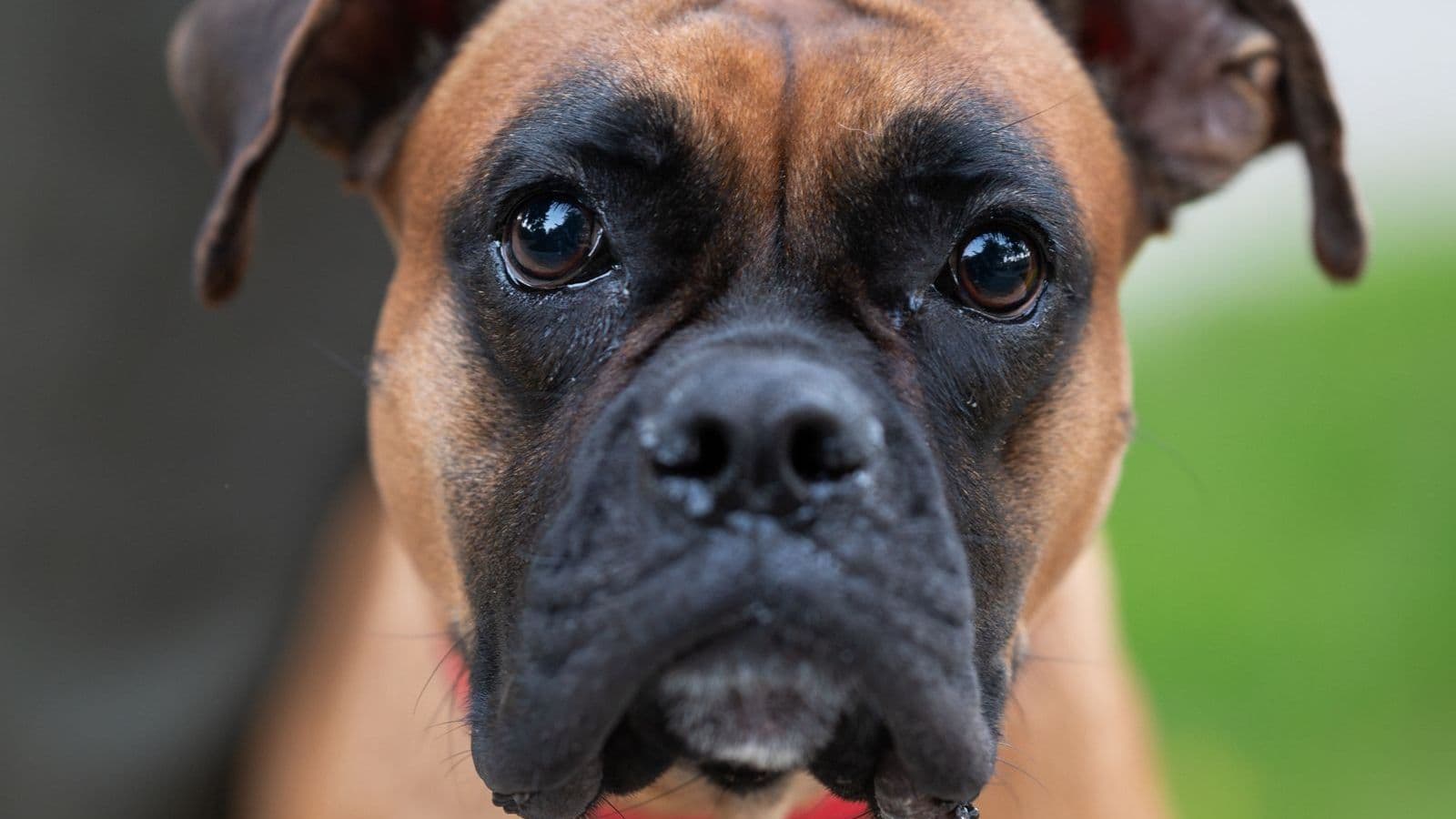
Boxers are exuberant, powerful, and stay puppy-like for nearly three years. That combination produces predictable training failures when owners apply normal-breed expectations to an abnormally long-developing dog. A Lab owner's timeline simply does not fit a Boxer, and most "my Boxer is out of control" stories are really "my expectations were calibrated for a different breed" stories.
The good news : every one of the eight mistakes below is fixable, and most are preventable outright. Here is what turns a wonderful breed into a chaotic one, why it happens to Boxers specifically, and what experienced Boxer owners do instead.
1. Expecting calm adult behavior too early
Boxers mature at 2.5 to 3 years, far slower than most breeds. Owners who expect a settled dog at 12 months conclude their Boxer is "hyperactive" or "untrainable", when in fact the dog is developmentally still a puppy in a 60-pound athlete's body. This mislabel matters : owners who think training failed often stop training exactly when the dog needs it most. Plan for the long adolescence from day one. Keep sessions short, daily, and consistent straight through the teenage months, and do not measure your Boxer against the neighbor's settled 18-month-old Golden. The calm adult arrives, reliably, just a year or so later than you expected.
2. Inconsistent jumping rules
Jumping is the number one Boxer complaint, and it is almost always owner-created. This breed greets with its whole body, and every person who lets the Boxer jump "because it's cute" while it is a 15-pound puppy is training the 65-pound adult to do the same. Worse, pushing the dog off is also attention, which also reinforces it. The fix is total, boring consistency :
- Four paws on the floor gets attention, praise, and treats.
- Any paw lifting toward a person turns that person into a silent statue.
- Guests get briefed at the door, before the dog reaches them.
- Greetings start only once the dog sits or stands calmly.
One inconsistent household member or indulgent visitor keeps the behavior alive indefinitely. See our jumping guide for the full protocol.
3. Insufficient exercise
Boxers are athletic working dogs needing 60 to 90 minutes of vigorous daily exercise, real running and play, not a stroll around the block. Under-exercised Boxers channel the surplus into destruction, jumping, mouthing, and the frantic zoomies-all-evening pattern owners describe as "crazy". The trap is that owners then treat an exercise deficiency as a training problem and add more corrections, which fixes nothing because the input was wrong. Before diagnosing any Boxer behavior issue, audit the exercise honestly. A tired Boxer is a trainable Boxer; an under-exercised one physically cannot give you the attention training requires.
4. Training and exercising in heat
Boxers have moderately flat faces, and that muzzle shortens their cooling capacity dramatically compared to longer-nosed breeds. Vigorous training or exercise in warm weather is a genuine medical risk, not a comfort preference : Boxers can overheat quickly, and heatstroke in a brachycephalic breed escalates fast. Schedule sessions for cool mornings and evenings in summer, keep water available at all times, watch for heavy panting, a wide "smiling" gape, or slowing down, and stop early rather than late. Indoor mental work is the correct substitute on hot days, a scent game tires a Boxer without cooking it.
5. Punishing mouthing and pawing
Boxers "box" with their front paws, it is literally how the breed got its name, and they tend to be mouthy well into adolescence. Both behaviors are partly instinctive, which is why punishing them mostly produces a confused dog and a damaged relationship rather than a polite one. The working fix is redirection : the instant paws or mouth come toward you, a toy appears and the game continues through the toy. Keep redirect toys stashed in every room during the puppy years. The behaviors fade with maturity when an alternative is consistently provided, and they persist for years when they are punished but never replaced.
6. Skipping impulse-control work
Boxers do not come with natural impulse control. They are enthusiastic, quick to arousal, and everything exciting is an emergency. Owners who skip explicit impulse-control training end up with a powerful adult that cannot contain itself around food, doors, guests, or other dogs. Build the skills deliberately, they do not develop on their own in this breed :
- Wait for the food bowl : bowl goes down, dog holds a sit until released.
- Doorway manners : door opens only while the dog stays seated.
- Settle on a mat : rewarded calm time while life happens around it.
- Tug with rules : take it, drop it, and pauses built into every game.
Ten minutes a day of this work is what separates the composed adult Boxer from the chaos machine.
7. Using harsh corrections
Despite the muscles and the guard-dog history, Boxers are emotionally soft and intensely people-focused. Harsh methods, leash pops, yelling, physical intimidation, produce anxious or shut-down Boxers and permanently dent the trusting, clownish temperament that makes the breed worth having. This is also simply wasted effort : a Boxer working FOR you learns in days what a Boxer working to avoid you never learns at all. Reward-based training, high-value treats, play as a reward, big genuine praise, is dramatically more effective on this breed.
8. Under-socializing a powerful breed
A poorly socialized Boxer is a large, fast, powerful dog whose reactivity is genuinely hard to manage at full size. The breed is naturally social and people-loving, which lulls owners into skipping the work, but that social baseline still needs exposure to become stability. During the 8-to-16-week window, bank calm, positive experiences : different people, dogs, surfaces, sounds, handling. Continue through adolescence with controlled greetings and neutral-dog exposure. The payoff is the classic friendly Boxer; the cost of skipping it is a 65-pound adolescent that lunges at everything interesting.
What works with Boxers
Patience through the long puppyhood, total consistency on jumping, a real exercise budget, heat awareness in every season plan, deliberate impulse-control work, and reward-based methods throughout. Owners who provide these get one of the most fun, loyal, family-safe dogs in existence, a clown with a bodyguard's devotion.
Owners who skip them get three years of chaos and then blame the breed. The breed was never the problem.
TailorPup's Boxer plan paces training across the extended adolescence, front-loads jumping and impulse-control protocols in the early weeks, and adjusts session intensity for temperature.
Frequently Asked Questions
Why is my Boxer so hyper?
Usually three stacked causes : the breed matures very late (2.5 to 3 years), the exercise budget is short of the 60-to-90-minute need, and impulse control was never explicitly trained. Fix all three and the "hyper" label disappears with time.
When do Boxers finally calm down?
Most settle noticeably between 2.5 and 3 years, later than almost any comparable breed. Consistent training through adolescence determines whether the calm adult is also a polite one.
How do I stop my Boxer from jumping on guests?
Total consistency : four on the floor earns attention, jumping turns people into statues, and guests are briefed before they meet the dog. Add a leash or gate at the door during the learning phase so the dog cannot rehearse jumping on arrivals.
Can Boxers handle hot weather training?
Poorly. Their shortened muzzle limits cooling, so train in the cool hours, keep sessions short, provide water, and swap to indoor mental work in heat. Overheating in this breed is a genuine emergency risk.
Start your Boxer's plan at tailorpup.com →
Related: How to Train a Boxer · Stop Jumping Guide · Recall Training