Understanding Your Dog's Play Style
Dog play looks like chaos to most owners, growling, body-slamming, teeth everywhere, but it has real structure and real rules. Learning to read it means you can let genuinely healthy play run its course, and step in early when it's tipping into something else.
Written by the TailorPup team, updated October 2026. See our editorial approach.
In this article · 9 sections+
01
The play bow: the universal invitation
The play bow, front legs down, chest low, rear end up, tail often wagging loosely, is one of the clearest signals in dog body language. It means 'everything that follows is play, not a real fight,' and dogs use it to punctuate rough moments during a session as a reminder: still playing, we're good.
A dog that play-bows before and during a wrestling match is actively communicating intent. Losing that signal (a dog that stops bowing and gets stiffer and more serious mid-play) is one of the earliest cues that the interaction is shifting.
02
Self-handicapping and role reversal
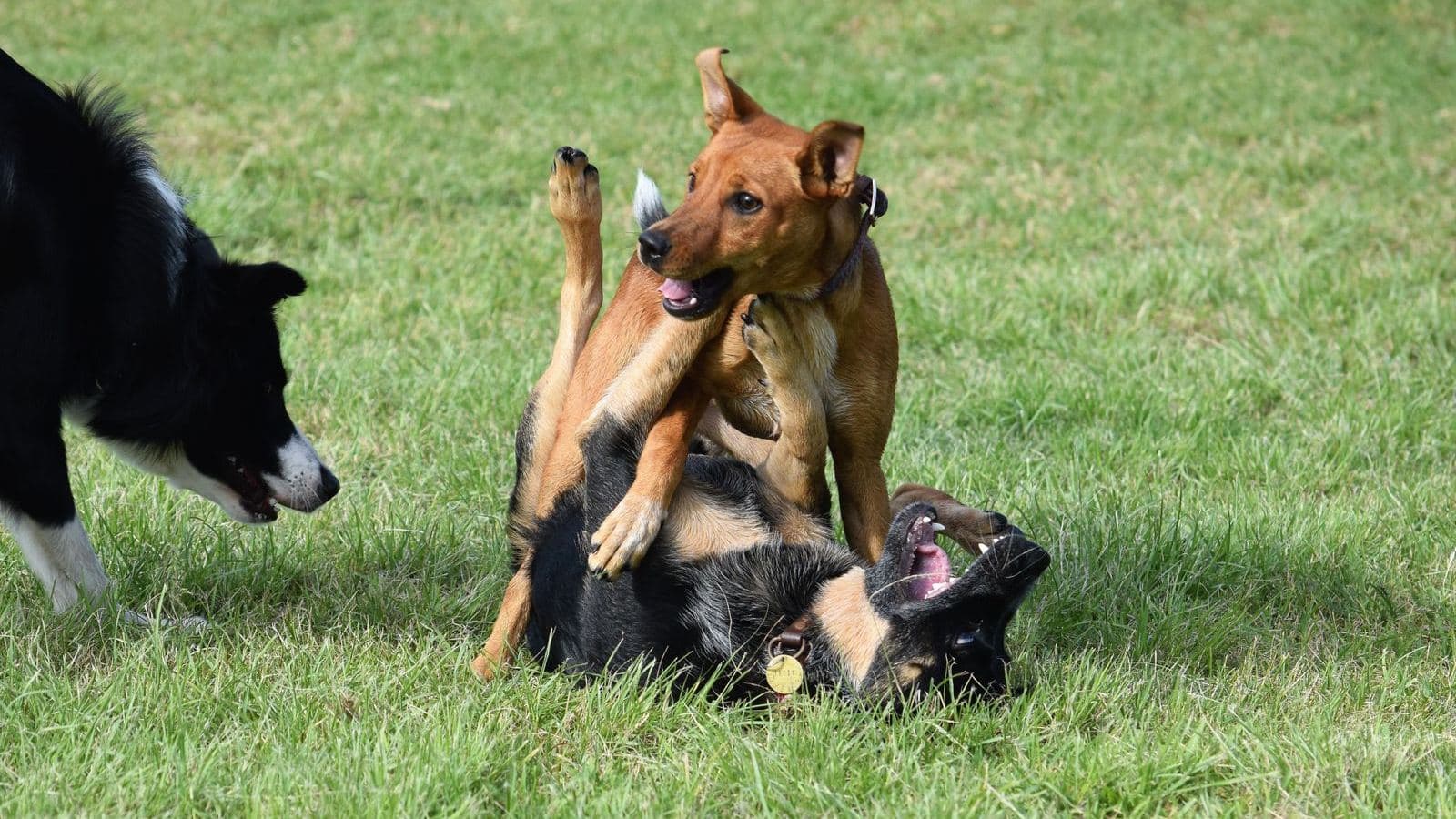
Healthy play includes self-handicapping: a bigger or stronger dog will voluntarily hold back, roll onto its back, or let a smaller dog get the upper hand for a while. Role reversal (chaser becomes chased, pinner becomes pinned) roughly every 30-60 seconds is another strong sign of balanced, mutual play rather than one dog dominating.
If one dog is always on top, always chasing, and the other never gets a turn or a break, that imbalance is worth watching closely, even without overt aggression.
03
Bite inhibition during play
Bite inhibition, the learned ability to control how hard a bite lands, gets built and reinforced largely through play with other dogs (and, for puppies, with people) starting around 8-16 weeks. A puppy that bites another dog too hard usually gets an instant, clear response: a yelp and a pause in play. That immediate consequence is how puppies learn to soften their mouths without a human ever intervening.
Well-socialized adult dogs continue to modulate bite pressure in play their whole lives, an open-mouthed, fast, springy bite with no pressure is normal play-fighting; a hard, sustained bite that doesn't let go is not.
04
Signs play is healthy
Loose, bouncy movement rather than stiff, frozen posture. Regular pauses, either dog can walk away and the other doesn't chase to force continuation. Reciprocal role-swapping. Open, relaxed mouths (a 'play face') rather than tightly closed lips or bared teeth. Both dogs returning to initiate more play after a break, that willingness to come back is one of the clearest 'this is working for both of us' signals.
05
Signs play is escalating and needs a break
Growling that gets lower and more constant rather than the loose, exaggerated play-growl. Stiff, frozen body posture, especially combined with a hard stare. One dog repeatedly trying to leave while the other blocks or chases. Hackles up combined with slow, stiff movement, rather than fast and loose. Any of these, especially in combination, is worth calmly interrupting with a recall or by physically separating the dogs, before it escalates further, not after.
06
What to do as the supervising owner
Interrupt with a recall cue periodically during play, even when things look fine, and reward coming away, this keeps both dogs practicing disengagement so they can do it easily if a real interrupt is ever needed. Give both dogs a short break if the intensity is climbing, most healthy play naturally cools back down after 30-60 seconds apart. If either dog cannot calm down even after a break, or if the same worrying signs keep repeating, end the session for the day rather than hoping it self-corrects.
07
Healthy play versus trouble
Use this quick guide.
- Healthy: loose, bouncy movement, play bows, role reversal and pauses.
- Healthy: both dogs choose to keep playing and take turns chasing.
- Trouble: stiff body, hard stare, one dog trying to escape.
- Trouble: growling that sounds serious, pinning or relentless chasing.
08
How to step in
A calm break can prevent a fight.
- Call the dogs away in a cheerful voice and reward them for coming.
- Have a short break and let both dogs settle.
- Restart the game if both look relaxed.
- End the session if tension continues.
09
Choosing play partners
Dogs with similar size, energy and style tend to play best together. A dog that likes to wrestle may overwhelm one that prefers chasing. Arrange play with dogs your dog enjoys, and avoid forcing contact.
FAQ
Common follow-ups.
Is growling during play always bad?+
No. A loose, sing-song growl during wrestling is a completely normal part of dog play. A low, constant, tense growl combined with stiff body language is the version worth interrupting.
My dog play-bows but the other dog ignores it. What does that mean?+
It can mean the other dog is not interested in play right now, or is over-aroused and not communicating clearly itself. Watch closely, one dog signaling play while the other stays stiff is a mismatch worth managing rather than letting continue unsupervised.
How do I teach my puppy bite inhibition if it has no dog playmates yet?+
You can do this yourself: yelp and briefly withdraw attention the instant your puppy's teeth land too hard on your hand during play, then re-engage a few seconds later. This mirrors exactly what a littermate or playmate would do.
Is growling during play normal?+
Some play growling is normal, but watch the rest of the body. If it is paired with stiffness or fear, step in.
Should I let dogs sort it out?+
Allow healthy play. Interrupt if it gets too rough or one dog wants to leave.
Glossary