Training a Deaf Dog
A deaf dog can learn almost everything a hearing dog can. The signals change from sound to sight and touch, and safety habits matter a little more. With hand signals, a visual marker and gentle attention, most deaf dogs become confident, happy companions.
Written by the TailorPup team, updated October 2026. See our editorial approach.
In this article · 11 sections+
01
Replace the marker word with a visual one
Marking the exact moment of success is the foundation of reward-based training. For a deaf dog, use a clear visual signal such as a thumbs up, a flash of a small light or a quick open hand.
- Choose one signal and keep it the same every time.
- Show the signal, then deliver a treat straight away. Repeat about 15 times.
- Mark real behaviors with the signal, then reward.
02
Teach an attention signal
Because you cannot call a deaf dog's name, you need a way to get its attention. Teach it to look at you when you give a signal, such as a wave, a stamp on the floor or a light vibration.
- Give the signal when the dog is looking away.
- When it looks at you, mark and reward.
- Practice in many places, until the dog looks reliably.
03
Use a vibration collar as a tap on the shoulder
A vibration collar can work like a tap on the shoulder. Teach it the same way as a marker: vibrate, then give a treat, until the dog looks at you.
04
Build hand signals like you would build words
Teach each behavior with a lure or by shaping, then add a hand signal just before the behavior. Over time, the signal replaces the lure.
- Sit: a raised palm.
- Down: a flat hand moving down.
- Stay: an open palm toward the dog.
- Come: a sweeping arm toward your chest.
05
Prioritize safety
A deaf dog cannot hear a car or a call. Keep it on a leash or a long line outside, use a securely fenced yard and teach a reliable check-in.
- Use a secure harness and ID tag that says deaf.
- Avoid off-leash areas near roads.
- Teach "look at me" in every new place.
- Consider a microchip and up-to-date contact details.
06
Wake and startle carefully
A deaf dog that is touched while asleep can startle. Teach everyone to wake it gently, for example by placing a treat under its nose or by touching its back lightly, and let it wake at its own pace.
EXAMPLE
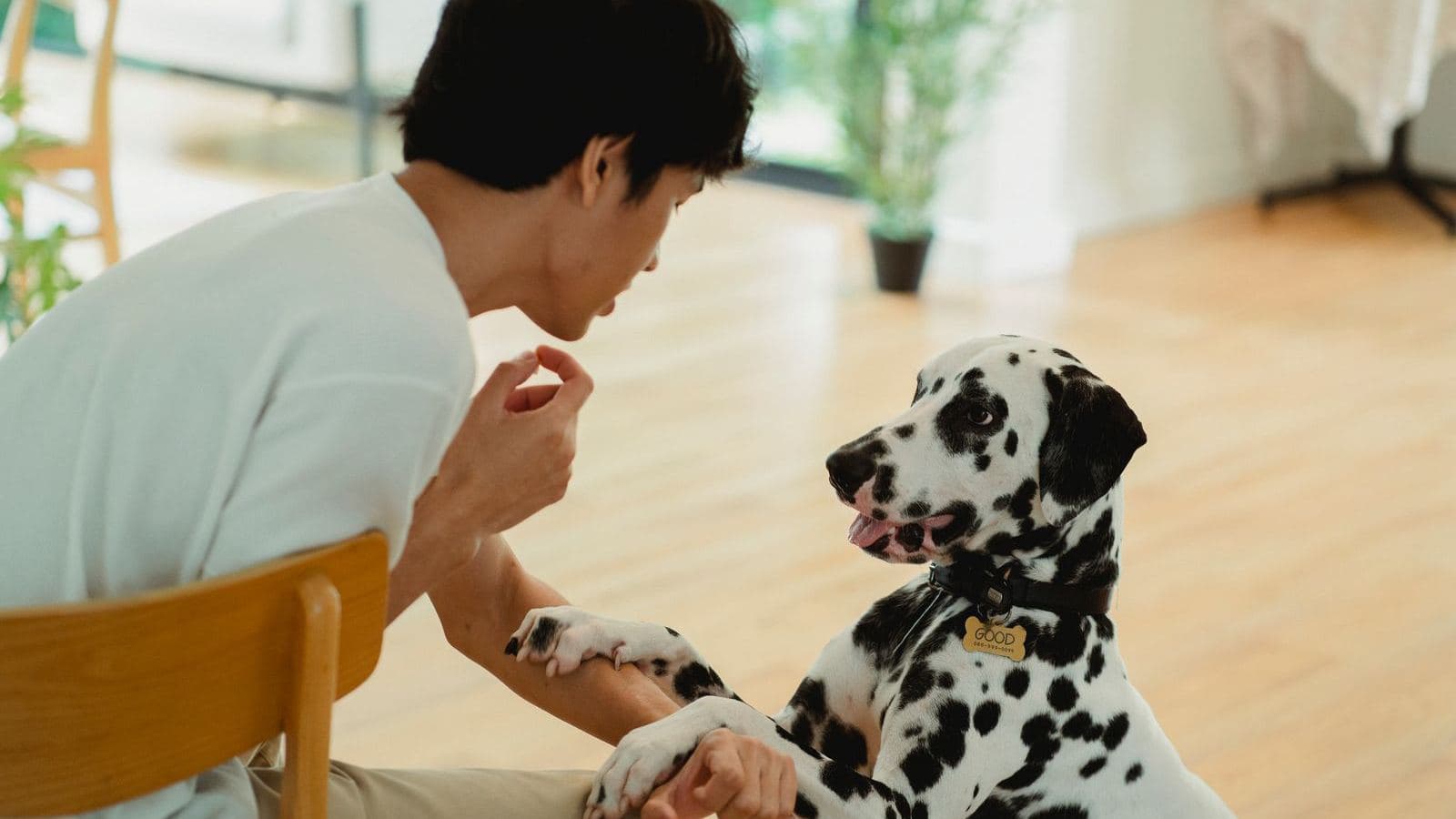
A worked example: Pearl, a deaf Dalmatian
Pearl was born deaf. Her owner chose a thumbs-up as a marker, and paired it with food for several days. Then she taught Pearl to look at her when she stamped on the floor, and added hand signals for sit and down.
Pearl learned quickly. A vibration collar, used only as a tap on the shoulder, helped when she was far away. In the garden she responded to a visual recall, but outside she always used a long line. Within months she was a confident, well-behaved dog.
IF IT STALLS
Troubleshooting
Common issues and solutions.
- The dog does not look at you: work in a quiet place and reward every glance.
- The dog startles when woken: teach family members to wake it gently with a scent or a light touch.
- The dog ignores signals: make them larger and consistent, and reward more.
- The dog is far away: use a vibration signal to get its attention, then a visual cue.
09
How deaf dogs communicate
Dogs naturally use body language, and deaf dogs rely on it even more. They read posture, movement, facial expression and touch. That is why many deaf dogs are very tuned in to their owners, and why visual signals work so well.
The key is to be clear and consistent. Use the same hand signals, the same body posture and the same rewards every time.
10
A four-week plan
This plan builds communication step by step.
- Week 1: choose a visual marker. Pair it with treats, 15 times, twice a day.
- Week 2: teach an attention signal and reward every glance.
- Week 3: teach sit and down with hand signals, using lures.
- Week 4: add a "come" signal and practice recall on a long line in a safe place.
11
Safety essentials
A deaf dog needs a bit more protection.
- A secure harness and a long line outdoors.
- A tag that says "deaf" and a microchip.
- A securely fenced garden.
- A way to get its attention at a distance, such as a vibration collar used as a tap.
- Care around sudden approaches, especially when the dog is asleep.
FAQ
Common follow-ups.
Can a deaf dog be trained off leash?+
Only in a safe, enclosed area. Many deaf dogs can learn a reliable visual recall, but safety comes first.
Are deaf dogs harder to train?+
Not necessarily. They need clear visual signals and a bit more planning, but they learn like other dogs.
How can I tell if my dog is deaf?+
Signs include not responding to sounds, sleeping through noise or startling when touched. A vet can confirm with a hearing test.
Do deaf dogs need other dogs?+
Not necessarily, but they can learn a lot from calm companion dogs. Introduce new dogs carefully.
Glossary
Terms used in this article.
Marker Word
A specific word, often "yes," used the same way a clicker is, to mark the exact instant a dog does the right thing.
Luring
Using a treat or toy held near a dog's nose to guide it into a position or movement.
Positive Reinforcement
Adding something the dog wants immediately after a behavior to increase the odds it happens again.